Oh my! The bigger the project, the bigger existential downer afterwards!
The reason I haven't posted here for a long time is because I had my masters recital last night. This was one hour of music that I have been focussing on since February - it is as though the whole year's work was distilled into that one event. The focus was intense, to say the least.
I find it really hard to evaluate my performance. There were a lot of things I was very pleased with, and also quite a few moments I was distinctly not pleased with. But I realised a few days ago that I never really believed that I could actually get up there and do it, so the very fact that I did it is excellent!
I had it recorded, and it will be interesting to listen back to the recording, and see how it sounded from the outside. Often I find, when listening back to recorded performances, that mistakes and glitches that seemed massive from the perspective of the performer actually are barely noticable, while other things that I was hardly aware of at the time stick out like sore thumbs.
But it's all in the past now.
And I'm facing a sink full of unwashed dishes and a desk full of unpaid bills. Welcome back to normality!
Thursday, November 30, 2006


Thursday, November 16, 2006
Sparkling shiraz
Life is full of meetings and partings. Some last for a lifetime, some for only a few hours. The length of time does not reflect the significance of the encounter. A moment shared between two people. A memory held for life. A smile, a glance, a kiss. They won’t be forgotten. The heart holds more than photographs.
Is a bittersweet parting at the airport better than a messy domestic break up in a year’s time? Or is it the safe option?
(and by the way, Tasmania was beautiful)
Is a bittersweet parting at the airport better than a messy domestic break up in a year’s time? Or is it the safe option?
(and by the way, Tasmania was beautiful)
Tuesday, November 07, 2006
Heading South
I'm off to Tasmania for a few days. I feel I may not be quite the same person when I return. I'll let you know...
Saturday, November 04, 2006
Saturday morning in Eltham
The sun was shining, but it's not any more. The air is sweet, though, and I have my front door open. I am hibernating this weekend. Today is the first day for a month that I haven't had to drive into the city, and I plan to make the most of it.
I am listening to
 and drinking organic orange juice, which is one of the best things eva :)
The plan for today is to practice, write, read, rest...
There is one phrase from a book I am reading which for some reason won't leave me alone: "every heart has secrets is dares not tell". I am not quite at peace with my life just now, there is a niggling feeling in my heart... but there's nothing I can do about it now, so it may just have to lie there for a while longer.
I am listening to
 and drinking organic orange juice, which is one of the best things eva :)
 The plan for today is to practice, write, read, rest...
There is one phrase from a book
I am reading which for some reason won't leave me alone: "every heart has secrets is dares not tell". I am not quite at peace with my life just now, there is a niggling feeling in my heart... but there's nothing I can do about it now, so it may just have to lie there for a while longer.
Thursday, November 02, 2006
What is Practice? Part 5...
Hello, My Name is Practice
I am planned and disciplined, spontaneous and creative.
I marry emotion and reason, technique and expression.
I am focus and imagination, work and play.
Sometimes I like to repeat things over and over again, listening for small changes each time. I gain insight through mantra.
Sometimes I like to perform for myself with abandon, not caring about wrong notes, but feeling the sweep of the music carry me away.
I can be a microscope, investigating the smallest detail of a trill, or a giant telescope, linking the constellations of movements, keys and themes.
I can lose myself in intricate detail and discover infinity in a simple melody.
My heart moves within and without time, capable of stretching split seconds into eternity, as well as beating crotchets at exactly 84 beats per minute.
I am deep stillness in contemplation, dancing movement, perseverance through frustration.
I listen, I feel, I touch, I remember, I discover, I am, I do.
I am a way of life, a meditation, a path of growth.
I am a musician’s personal liturgy.
I am planned and disciplined, spontaneous and creative.
I marry emotion and reason, technique and expression.
I am focus and imagination, work and play.
Sometimes I like to repeat things over and over again, listening for small changes each time. I gain insight through mantra.
Sometimes I like to perform for myself with abandon, not caring about wrong notes, but feeling the sweep of the music carry me away.
I can be a microscope, investigating the smallest detail of a trill, or a giant telescope, linking the constellations of movements, keys and themes.
I can lose myself in intricate detail and discover infinity in a simple melody.
My heart moves within and without time, capable of stretching split seconds into eternity, as well as beating crotchets at exactly 84 beats per minute.
I am deep stillness in contemplation, dancing movement, perseverance through frustration.
I listen, I feel, I touch, I remember, I discover, I am, I do.
I am a way of life, a meditation, a path of growth.
I am a musician’s personal liturgy.
Wednesday, November 01, 2006
Sci-Fi Soviet Architecture
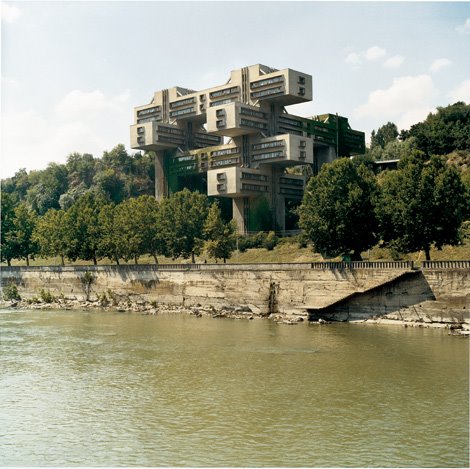
My new favourite place on the web, PingMag, has some photos by Frederic Chaubin of strange and wonderful buildings in what used to be the USSR. I want to know what they look like inside!
Sunday, October 29, 2006
What is Practice? Part 4 - Going Deeper
(Part 1)
(Part 2)
(Part 3)
The history of the word practice is quite interesting. The earliest recorded use in English was in 1392, when it meant "to do, act, or perform habitually." This came, via Old French, from Middle Latin practicare, meaning "to do, perform.” Here there is nothing about the purpose of acquiring a skill or proficiency. These earlier forms of the word are all about doing.
I started to think about the practice of a musical instrument in these terms.
What if practice was about doing? If the doing was the important part of the practice? What if the impending performance was not the supreme goal of the practice, it was merely a by-product? How does practice affect us as people, not just performance machines? Could I be a music practitioner, rather than a performer?
The word practice is used today not only in the context of music. It is often used when talking about spirituality, meditation and religion. If I practice meditation, how is that different to practicing my instrument? Could practicing my instrument become less like a chore and more like the practice of a belief-system? Something that flows through the whole of my life?
How well can I get to know a single note? How deeply can I inhabit the silence of a rest? How far can I stretch the space between two semiquavers?
Can I approach my practice with compassion, without judgement or guilt? Can I enjoy the journey without an obsessive need to arrive?
Could I view practice not as something that separates and isolates me from the world, but as something that connects me to a deep current of humanity?
Now I really have no answers to these questions, and I don’t really know if it is possible. Maybe this is all a bit way-out. But I am starting to formulate a picture in my mind’s eye of a possible practice…
This is a deep practice, working with vertical time, rather than horizontal time. There is no clock-watching.
This practice is about really knowing the music, getting completely settled with the material, and with myself.
This practice approaches the instrument with interest, and really listens to the sounds. There is awareness, rather than judgement.
This practice is a whole attitude to life. It is a lifestyle, encompassing much more than technique or even musicality.
It is a doing that involves aesthetics and philosophy, emotion, reason and soul. It affects not only the music but life itself.
* * *
If this practice could talk, maybe it would say…
...to be continued...
(Part 2)
(Part 3)
The history of the word practice is quite interesting. The earliest recorded use in English was in 1392, when it meant "to do, act, or perform habitually." This came, via Old French, from Middle Latin practicare, meaning "to do, perform.” Here there is nothing about the purpose of acquiring a skill or proficiency. These earlier forms of the word are all about doing.
I started to think about the practice of a musical instrument in these terms.
What if practice was about doing? If the doing was the important part of the practice? What if the impending performance was not the supreme goal of the practice, it was merely a by-product? How does practice affect us as people, not just performance machines? Could I be a music practitioner, rather than a performer?
The word practice is used today not only in the context of music. It is often used when talking about spirituality, meditation and religion. If I practice meditation, how is that different to practicing my instrument? Could practicing my instrument become less like a chore and more like the practice of a belief-system? Something that flows through the whole of my life?
How well can I get to know a single note? How deeply can I inhabit the silence of a rest? How far can I stretch the space between two semiquavers?
Can I approach my practice with compassion, without judgement or guilt? Can I enjoy the journey without an obsessive need to arrive?
Could I view practice not as something that separates and isolates me from the world, but as something that connects me to a deep current of humanity?
Now I really have no answers to these questions, and I don’t really know if it is possible. Maybe this is all a bit way-out. But I am starting to formulate a picture in my mind’s eye of a possible practice…
This is a deep practice, working with vertical time, rather than horizontal time. There is no clock-watching.
This practice is about really knowing the music, getting completely settled with the material, and with myself.
This practice approaches the instrument with interest, and really listens to the sounds. There is awareness, rather than judgement.
This practice is a whole attitude to life. It is a lifestyle, encompassing much more than technique or even musicality.
It is a doing that involves aesthetics and philosophy, emotion, reason and soul. It affects not only the music but life itself.
* * *
If this practice could talk, maybe it would say…
...to be continued...
Thursday, October 26, 2006
Post-show blues
Oh, how I hate the day after. The day after the big gig, the day after the show ends, the day after it is all over and life threatens to go back to grey normality. Why is it always at this time that the question of my future and what I am to do with it looms large?
Tuesday, October 24, 2006
What is Practice? Part 3 - On the surface – Practice as Preparation for Performance
(Part 1)
(Part 2)
Certainly much of our practice is geared towards acquiring skill or proficiency. There is a certain level of technical ability required to play a musical instrument, and we need to be able to play the right notes at the right pitch at the right speed.
To gain this technical proficiency, we “play… things that nobody would want to listen to. This might include scales, arpeggios, extended tones…, and various technical patterns.” As Chad Fowler remarks:
I would certainly never record them and release them on a CD. I wouldn't even bore anyone with these sounds unless they either lived in my house and had no choice or were being paid to listen to them and offer suggestions for improvement.
But we don’t want to acquire technical skill just for the sake of having technical skill. No, we want to perform for an audience. So practice could also be defined as the preparation for performance. Private, isolated practice in preparation for public performance.
So we practice our pieces, work on the fingering for a particular passage, play those bars over and over again until we cannot possibly make a mistake. We analyse the harmony, and impart meaning into the melody. We turn the piece of music inside out and find out how it was put together, so we can re-create it in our own interpretation. We try to get under the skin of the music, to feel its emotions as our own.
This process of preparing for performance takes time, patience, discipline, and often seems like a lot of hard work. But the goal is in sight – that big recital. Wow, won’t it be great to have achieved that! All this hard work will have been worth it!
But what happens when that big recital has been? Our practice is not at an end. We still have to turn up at the instrument the next day, continuing to hone our technique and learning the music for the next gig. Just like the proverbial housework, practice is never really done.
In our practice we are constantly striving towards some future date, focussed on a target that keeps moving as our goals grow and shift. We are never satisfied because what we are working for is never now. It is always somewhere in the future.
Practice can be very easily seen as merely the means to an end, the road by which we arrive at our real goals as musicians – performance. Because, after all, we’re performers, not practicers, aren’t we?
(Part 2)
Certainly much of our practice is geared towards acquiring skill or proficiency. There is a certain level of technical ability required to play a musical instrument, and we need to be able to play the right notes at the right pitch at the right speed.
To gain this technical proficiency, we “play… things that nobody would want to listen to. This might include scales, arpeggios, extended tones…, and various technical patterns.” As Chad Fowler remarks:
I would certainly never record them and release them on a CD. I wouldn't even bore anyone with these sounds unless they either lived in my house and had no choice or were being paid to listen to them and offer suggestions for improvement.
But we don’t want to acquire technical skill just for the sake of having technical skill. No, we want to perform for an audience. So practice could also be defined as the preparation for performance. Private, isolated practice in preparation for public performance.
So we practice our pieces, work on the fingering for a particular passage, play those bars over and over again until we cannot possibly make a mistake. We analyse the harmony, and impart meaning into the melody. We turn the piece of music inside out and find out how it was put together, so we can re-create it in our own interpretation. We try to get under the skin of the music, to feel its emotions as our own.
This process of preparing for performance takes time, patience, discipline, and often seems like a lot of hard work. But the goal is in sight – that big recital. Wow, won’t it be great to have achieved that! All this hard work will have been worth it!
But what happens when that big recital has been? Our practice is not at an end. We still have to turn up at the instrument the next day, continuing to hone our technique and learning the music for the next gig. Just like the proverbial housework, practice is never really done.
In our practice we are constantly striving towards some future date, focussed on a target that keeps moving as our goals grow and shift. We are never satisfied because what we are working for is never now. It is always somewhere in the future.
Practice can be very easily seen as merely the means to an end, the road by which we arrive at our real goals as musicians – performance. Because, after all, we’re performers, not practicers, aren’t we?
Thursday, October 19, 2006
What is Practice? Part 2 - As Described by Others
(part 1 of What is Practice? is here)
When I questioned music students about what they thought practice was, the answers included: “Torture”; “A process of trying to improve your technical skills”; “To work on something to attain a high standard or perfection. This involves an amount of repetition.”; “Repetition in the hope of getting it better.”; and “Working at getting something right – getting better at something.”
So far, these are not particularly positive descriptions. They involve work, repetition, slogging away at the instrument for some future glory.
When I looked up the dictionary, I found that practice could be “a habitual or customary performance”, “a habit or custom”, “repeated performance or systematic exercise for the purpose of acquiring skill or proficiency”, “skill gained by experience or exercise”, or “the action or process of performing or doing something” .
It is the third of these definitions that many, if not most, music students, and certainly myself, generally associate with the idea of practicing our instruments: “repeated performance or systematic exercise for the purpose of acquiring skill or proficiency.”
When I questioned music students about what they thought practice was, the answers included: “Torture”; “A process of trying to improve your technical skills”; “To work on something to attain a high standard or perfection. This involves an amount of repetition.”; “Repetition in the hope of getting it better.”; and “Working at getting something right – getting better at something.”
So far, these are not particularly positive descriptions. They involve work, repetition, slogging away at the instrument for some future glory.
When I looked up the dictionary, I found that practice could be “a habitual or customary performance”, “a habit or custom”, “repeated performance or systematic exercise for the purpose of acquiring skill or proficiency”, “skill gained by experience or exercise”, or “the action or process of performing or doing something” .
It is the third of these definitions that many, if not most, music students, and certainly myself, generally associate with the idea of practicing our instruments: “repeated performance or systematic exercise for the purpose of acquiring skill or proficiency.”
Wednesday, October 18, 2006
We set the fire alarm off!
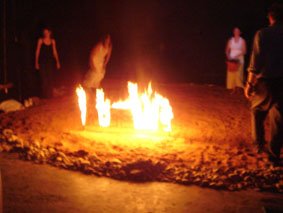 Last night, in our dress rehearsal, all was going to plan: Margie was lighting the burning town, it was looking fabulous. Then whoop-whoop-beep-beep-beep "please evacuate the space now, and make your way to the assembly point outside..."
The smoke alarms in the venue had been isolated, but not the ones in the School of Art ceramic studio next door. And the smoke travelled through the vents in the walls...
I think the audience thought it was part of the show! Luckily it was a balmy evening, and the bar next door was open, so we sat outside with a beer for a while, waiting for the firemen to tell us it was safe to go back in!
Tuesday, October 17, 2006
What is Practice? Part 1 - My Experience
I presented a phemomenology of practice in my masters seminar last week. This is the first of a 4-part series containing some excerpts from the paper. I found that through writing the paper I have started to radically re-think the concept of practice, and what it means in my life.
I started by thinking about my personal experience of practice...
I think it’s fair to say, that until now I have on the whole been unhappy with my practice. I used to think that it was a burden to be grudgingly borne on the rocky road to the glittering hall of performance, but I am not so sure now. If I am to be a musician, it is something that I am going to have to do a lot of, and I am determined to find a way to make it an integral and enjoyable part of my life if that is at all possible.
So I set out to find what it is, why I have had such a fractured relationship with it, and what it has the potential to be in my life.
I don’t really remember much about practice from when I was a child. I remember playing the piano, but I don’t really remember practicing. I am not sure what distinction I am making between playing and practicing here, but I think it might have something to do with making a conscious decision to aim to improve the playing of a piece or to get to know it better. That’s an interesting phrase: to get to know a piece. There’s “knowing the notes”, which is different from “knowing” or “getting to know” in terms of making friends or becoming acquainted with the music.
I know that I have never thought that I have done enough practice, that I have never felt completely prepared for a performance. So that is one thing that I have seen practice as: preparation for performance. I wonder what “enough practice” would feel like – does anyone ever think they have done enough practice? I have always seen practice as hard, long, boring work that I have put off for as long as possible. It has connotations of endless hours at the instrument, repeating the same passage over and over again. It is necessary drudgery – slaving over a hot keyboard. Hours of scales; up and down, up and down, up and down.
I feel frustrated when I am practicing, and feel that I don’t quite know how to do it properly. No-one ever taught me how to practice. I don’t want to dislike practice. I don’t want to spend hours each day doing something I don’t enjoy. I am sure there is a way of enjoying practice, and I think I have felt glimpses of this occasionally. I don’t always hate practice, but it is certainly not something I look forward to. What do I think it is? Why do I not look forward to it?
I see it as stealing time away from me, and I feel directionless and unsure of what and how to practice. No matter what I am practicing, I wonder whether there is something else that I should be working on. I am not confident about my own decisions about what and how to practice. I don’t know how to measure my practice – how to know whether I am doing the right thing or whether I am doing enough of it.
I also find it hard to focus on one detail of the music when there are so many others clamouring for attention, and I often get discouraged.
There is a lot of guilt attached to my practice – either I’m not doing enough or I’m not doing the right thing. I can’t remember ever being entirely satisfied with a practice session. There is always the feeling that somehow I cheated, took the easy way out, glossed over something, or gave up on it. I have seen practice as something that is to be endured rather than enjoyed, and something that I have tried to do as little as possible of, rather than as much as possible. I don’t know what effective and enjoyable practice is – I’ve never done it. I think I’ve always just ended up playing things over and over again, hoping that somehow it would sink in. There’s a lot of blind hoping and not really feeling secure with anything. I feel that basically I have been flying by the seat of my pants. I haven’t really “known” the music that I’ve performed, and I’ve trusted to luck that I’d get most of the notes right.
I started by thinking about my personal experience of practice...
I think it’s fair to say, that until now I have on the whole been unhappy with my practice. I used to think that it was a burden to be grudgingly borne on the rocky road to the glittering hall of performance, but I am not so sure now. If I am to be a musician, it is something that I am going to have to do a lot of, and I am determined to find a way to make it an integral and enjoyable part of my life if that is at all possible.
So I set out to find what it is, why I have had such a fractured relationship with it, and what it has the potential to be in my life.
I don’t really remember much about practice from when I was a child. I remember playing the piano, but I don’t really remember practicing. I am not sure what distinction I am making between playing and practicing here, but I think it might have something to do with making a conscious decision to aim to improve the playing of a piece or to get to know it better. That’s an interesting phrase: to get to know a piece. There’s “knowing the notes”, which is different from “knowing” or “getting to know” in terms of making friends or becoming acquainted with the music.
I know that I have never thought that I have done enough practice, that I have never felt completely prepared for a performance. So that is one thing that I have seen practice as: preparation for performance. I wonder what “enough practice” would feel like – does anyone ever think they have done enough practice? I have always seen practice as hard, long, boring work that I have put off for as long as possible. It has connotations of endless hours at the instrument, repeating the same passage over and over again. It is necessary drudgery – slaving over a hot keyboard. Hours of scales; up and down, up and down, up and down.
I feel frustrated when I am practicing, and feel that I don’t quite know how to do it properly. No-one ever taught me how to practice. I don’t want to dislike practice. I don’t want to spend hours each day doing something I don’t enjoy. I am sure there is a way of enjoying practice, and I think I have felt glimpses of this occasionally. I don’t always hate practice, but it is certainly not something I look forward to. What do I think it is? Why do I not look forward to it?
I see it as stealing time away from me, and I feel directionless and unsure of what and how to practice. No matter what I am practicing, I wonder whether there is something else that I should be working on. I am not confident about my own decisions about what and how to practice. I don’t know how to measure my practice – how to know whether I am doing the right thing or whether I am doing enough of it.
I also find it hard to focus on one detail of the music when there are so many others clamouring for attention, and I often get discouraged.
There is a lot of guilt attached to my practice – either I’m not doing enough or I’m not doing the right thing. I can’t remember ever being entirely satisfied with a practice session. There is always the feeling that somehow I cheated, took the easy way out, glossed over something, or gave up on it. I have seen practice as something that is to be endured rather than enjoyed, and something that I have tried to do as little as possible of, rather than as much as possible. I don’t know what effective and enjoyable practice is – I’ve never done it. I think I’ve always just ended up playing things over and over again, hoping that somehow it would sink in. There’s a lot of blind hoping and not really feeling secure with anything. I feel that basically I have been flying by the seat of my pants. I haven’t really “known” the music that I’ve performed, and I’ve trusted to luck that I’d get most of the notes right.
Sunday, October 15, 2006
Sunday morning
Sam, Jess and Tom - thanks for coming round for dinner last night. It was really great to hang out and cook, drink wine, and dance together.
My offering for you this morning is a meme from Liz.
46 random questions about me...
Have you ever:
1. Taken a picture completely naked? no
2. Danced in front of a mirror naked? no
3. Told a lie? yes
4. Had feelings for someone who didn't have them back? yes
5. Been arrested? no
6. Seen someone die? no
7. Kissed a picture? no
8. Slept in until 5pm? no
9. Had sex at work (on the clock)? no
10. Fallen asleep at work/school? yes
11. Held a snake? yes
12. Ran a red light? yes
13. Been suspended from school? no
14. Pole danced? no
15. Been fired from a job? no
16. Sang karaoke? no
17. Done something you told yourself you wouldn't? yes
18. Laughed until something you were drinking came out your nose? yes
19. Laughed until you peed? no
20. Caught a snowflake on your tongue? no
21. Kissed in the rain? yes
22. Had sex in the rain? no
23. Sang in the shower? yes
24. Gave your private parts a nickname? no
25. Ever gone to school/work without underwear? no
26. Sat on a roof top? yes
27. Played chicken? no
28. Been pushed into a pool with all your clothes on? no
29. Broken a bone? yes
30. Flashed someone? no
31. Mooned someone? no
32. Shaved your head? yes
33. Slept naked? yes
34. Blacked out from drinking? no
35. Played a prank on someone? yes
36. Had a gym membership? yes
37. Felt like killing someone? no
38. Cried over someone you were in love with? yes
39. Had Mexican jumping beans for pets? no
40. Been in a band? no
41. Shot a gun? yes
42. Shot a bow and arrow? yes
43. Played strip poker? no
44. Donated Blood? no
45. Ever jump out of an airplane? no
46. Been to more than 10 countries? no
So there. Quite tame, really.
My offering for you this morning is a meme from Liz.
46 random questions about me...
Have you ever:
1. Taken a picture completely naked? no
2. Danced in front of a mirror naked? no
3. Told a lie? yes
4. Had feelings for someone who didn't have them back? yes
5. Been arrested? no
6. Seen someone die? no
7. Kissed a picture? no
8. Slept in until 5pm? no
9. Had sex at work (on the clock)? no
10. Fallen asleep at work/school? yes
11. Held a snake? yes
12. Ran a red light? yes
13. Been suspended from school? no
14. Pole danced? no
15. Been fired from a job? no
16. Sang karaoke? no
17. Done something you told yourself you wouldn't? yes
18. Laughed until something you were drinking came out your nose? yes
19. Laughed until you peed? no
20. Caught a snowflake on your tongue? no
21. Kissed in the rain? yes
22. Had sex in the rain? no
23. Sang in the shower? yes
24. Gave your private parts a nickname? no
25. Ever gone to school/work without underwear? no
26. Sat on a roof top? yes
27. Played chicken? no
28. Been pushed into a pool with all your clothes on? no
29. Broken a bone? yes
30. Flashed someone? no
31. Mooned someone? no
32. Shaved your head? yes
33. Slept naked? yes
34. Blacked out from drinking? no
35. Played a prank on someone? yes
36. Had a gym membership? yes
37. Felt like killing someone? no
38. Cried over someone you were in love with? yes
39. Had Mexican jumping beans for pets? no
40. Been in a band? no
41. Shot a gun? yes
42. Shot a bow and arrow? yes
43. Played strip poker? no
44. Donated Blood? no
45. Ever jump out of an airplane? no
46. Been to more than 10 countries? no
So there. Quite tame, really.
Friday, October 13, 2006
Festival shenanigans
Went to the opening night party for the Melbourne Festival last night. The champagne was flowing freely and the dance floor was groovin!
Hence I am rather less than eloquent today. We don't open until Thursday night next week, and there's a lot of work still to be done on the show. I did manage to sneak a half hour nap on a couch this afternoon, though :)
Hence I am rather less than eloquent today. We don't open until Thursday night next week, and there's a lot of work still to be done on the show. I did manage to sneak a half hour nap on a couch this afternoon, though :)
Sunday, October 08, 2006
Still alive
Sleep definitely helps. With a lot of things. It is amazing how much easier it is to do stuff when I've had enough sleep. Who would have thunk? :)
I'm currently working on the practice paper. It's still daunting, but not as much as it was a couple of days ago, and my ideas are starting to crystallise. I have realised that I have never really been confident of my ability to practice, and have not trusted myself to make the right decisions about practicing. Somehow I always doubt myself, and find it really hard to measure or evaluate my practice. I think there is a lot of guilt attached to my practice - I feel that either I'm not doing enough or I'm not doing the right thing. I'm not really sure exactly what practice is yet, but I think I'm getting closer.
Stephen Nachmanovitch, in his book Free Play , describes practice as the "encounter with the gap between what we feel and what we can express", which is very similar to the way I feel about this paper right now. I think it's all in my head somewhere, but I am finding it really hard to get it down on paper.
I'm currently working on the practice paper. It's still daunting, but not as much as it was a couple of days ago, and my ideas are starting to crystallise. I have realised that I have never really been confident of my ability to practice, and have not trusted myself to make the right decisions about practicing. Somehow I always doubt myself, and find it really hard to measure or evaluate my practice. I think there is a lot of guilt attached to my practice - I feel that either I'm not doing enough or I'm not doing the right thing. I'm not really sure exactly what practice is yet, but I think I'm getting closer.
Stephen Nachmanovitch, in his book Free Play
, describes practice as the "encounter with the gap between what we feel and what we can express", which is very similar to the way I feel about this paper right now. I think it's all in my head somewhere, but I am finding it really hard to get it down on paper.
Friday, October 06, 2006
Overwhelming craziness
Crazy crazy crazy... we've got less than two weeks to go before Navigators opens at the Melbourne Festival. I feel like it's starting to come together, but there's still a lot of work to do, and I'm feeling quite overwhelmed by everything that's going on at the moment.
I burst into tears at my harpsichord lesson yesterday, just feeling like there is an insurmountable mountain of work that has to be done before my recital at the end of November. My teacher was very understanding, and handed me tissues while helping me work it all out.
I've got to present a phenomenological investigation of practice in my Masters seminar on Wednesday, and I have hardly started on it, so this weekend is going to be spent on that.
My grandmother died last weekend, which was sad, but also a blessing, as she had been suffering for a long time. She turned 100 years old in February, and had a long, happy and fulfilled life. The funeral was yesterday, which was a small ceremony conducted by my mother, auntie and uncle, and attended by the close family.
Right now I'm actually at work, sneaking five minutes to write this. I know that when I get home tonight, I will be too tired to do anything but collapse into my bed.
Anyway, this is not meant to be whingey or a plea for sympathy, it's just how it is right now.
I burst into tears at my harpsichord lesson yesterday, just feeling like there is an insurmountable mountain of work that has to be done before my recital at the end of November. My teacher was very understanding, and handed me tissues while helping me work it all out.
I've got to present a phenomenological investigation of practice in my Masters seminar on Wednesday, and I have hardly started on it, so this weekend is going to be spent on that.
My grandmother died last weekend, which was sad, but also a blessing, as she had been suffering for a long time. She turned 100 years old in February, and had a long, happy and fulfilled life. The funeral was yesterday, which was a small ceremony conducted by my mother, auntie and uncle, and attended by the close family.
Right now I'm actually at work, sneaking five minutes to write this. I know that when I get home tonight, I will be too tired to do anything but collapse into my bed.
Anyway, this is not meant to be whingey or a plea for sympathy, it's just how it is right now.
Wednesday, September 27, 2006
Listening
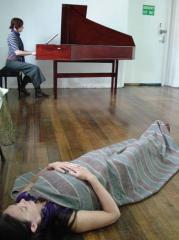 On Friday last week I presented a short piece that I had written for the Navigators Project. I think listening to music while lying on the ground should be done more often :)
(thanks to Voin for the pic!)
Tuesday, September 26, 2006
Procrastination Queen
I am the queen of procrastination. I have been avoiding this blog like the plague. It's not that I have forgotten it, or that I've been stuck for ideas about stuff to write about. No, not at all. I've simply been procrastinating.
Granted, life is kinda crazy busy right now - but when is that not the case? We have this unarticulated fantasy that at some point in the future there will be enough time to do the things we are not doing now because we are too busy. I know for a fact that's never going to be the case with me. I am always trying to do enough things for 3 people - right now it is:
- working full-time on the Melbourne Festival show
- studying full-time
- working half-time for money
There is a paradox for me where I get really inspired and motivated when I'm busy, but not for the thing I'm supposed to be working on. When I'm practicing, I'll have a great idea for a theatre show; when I'm in a lecture, I'll have an idea for a song, but when I sit down at the instrument the last thing that I want to do is work on the song. I seem to get the motivation all in the wrong places! And then when I do have a few hours of free time on the weekend, do you think that I want to jump into that project that I've been dreaming about all week? Of course not! I want to sit on the couch with a cup of coffee and the Sunday papers. Time and motivation for me seem not to connect and the result is procrastination.
Granted, life is kinda crazy busy right now - but when is that not the case? We have this unarticulated fantasy that at some point in the future there will be enough time to do the things we are not doing now because we are too busy. I know for a fact that's never going to be the case with me. I am always trying to do enough things for 3 people - right now it is:
- working full-time on the Melbourne Festival show
- studying full-time
- working half-time for money
There is a paradox for me where I get really inspired and motivated when I'm busy, but not for the thing I'm supposed to be working on. When I'm practicing, I'll have a great idea for a theatre show; when I'm in a lecture, I'll have an idea for a song, but when I sit down at the instrument the last thing that I want to do is work on the song. I seem to get the motivation all in the wrong places! And then when I do have a few hours of free time on the weekend, do you think that I want to jump into that project that I've been dreaming about all week? Of course not! I want to sit on the couch with a cup of coffee and the Sunday papers. Time and motivation for me seem not to connect and the result is procrastination.
Thursday, September 07, 2006
Practice again
It has been a struggle to get practicing again after my 2-week hiatus. On Monday I couldn't face the instrument, on Tuesday afternoon I tuned and improvised and played a couple of my recital pieces, yesterday I did about an hour's serious practice, and today it was close to two hours. Being a musician requires a ridiculous amount of self-discipline, and sometimes I wonder whether I am up to the task.
Tuesday, September 05, 2006
Home again, home again, jiggity jig
 It is very strange to be back in 'civilisation' after spending the past two weeks in the seeming emptiness of far north Queensland. There is no way I can possibly encapsulate the entire trip into words, and certainly not in one post, so I will simply give some of my impressions, and elaborate on them at another time.
- Time is a strange thing - my whole perception of time changed while I was away, and to my surprise, the hours of travel along dusty dirt roads passed quickly and became almost like a meditation.
- The way we percieve different landscapes changes the longer we spend time there - many times during the trip I felt quite alien from the landscape when I first arrived in a place, and was sure I would never feel comfortable or at home there, but after a day in that place I started to feel quite differently about it.
- Australia is truly a land of contrasts - we would be travelling through parched, dry bushland and suddenly come across a beautiful billabong with waterlilies and brolgas; at other times we would be standing on a paradise beach with coconut palms and azure sea, but not be able to swim because of the deadly crocodiles and stingrays; in the dry season the rivers are only stagnant puddles along dry watercourses, when in the wet they rise 10 meters and cut off all road access.
- The amazing warmth and generosity shown to us by the three indigenous communities we visited will touch me forever, I think. It was one of the most beautiful and humbling things that I have ever experienced, to be welcomed with open arms by people who have been so dreadfully wronged by the culture that I represent.
Subscribe to:
Posts (Atom)

